
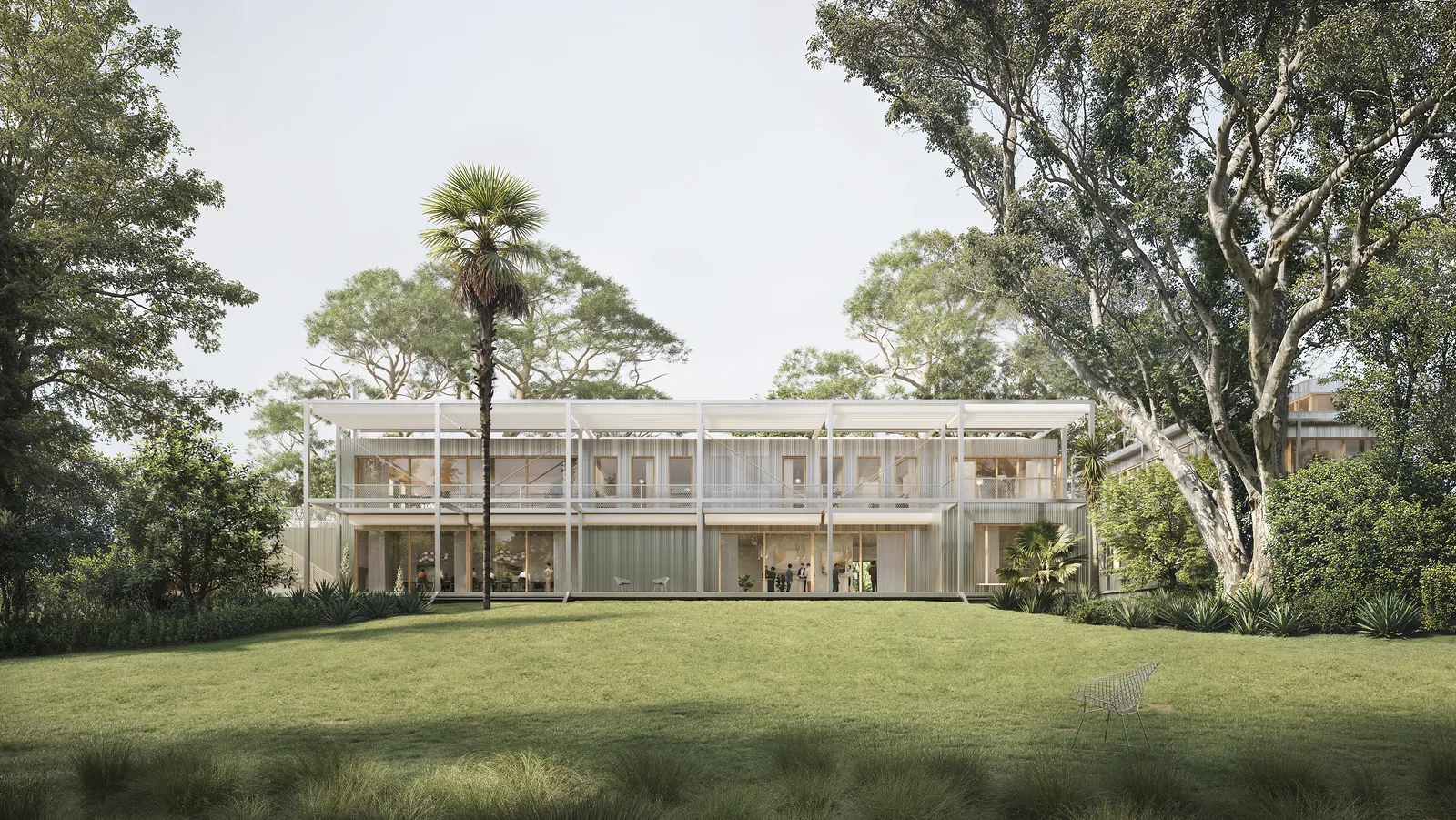
The embassy offices and residence for the German Embassy in Canberra, Australia, are to be rebuilt on the site at the corner of Empire Circuit and Turrana Road. The site is currently occupied by buildings dating from 1958. Demolishing and rebuilding the chancellery and renovating or partially preserving the residence building are considered the most sustainable and economical solution. The central goal of the urban development concept is to sensitively integrate the new structures into the existing environment.
The strong, landscape-dominated topography of the site and the valuable tree population, some of which is decades old, form the starting point for the design considerations. These natural conditions are not seen as restrictions, but as identity-forming elements that significantly influence the positioning and formulation of the building volumes.
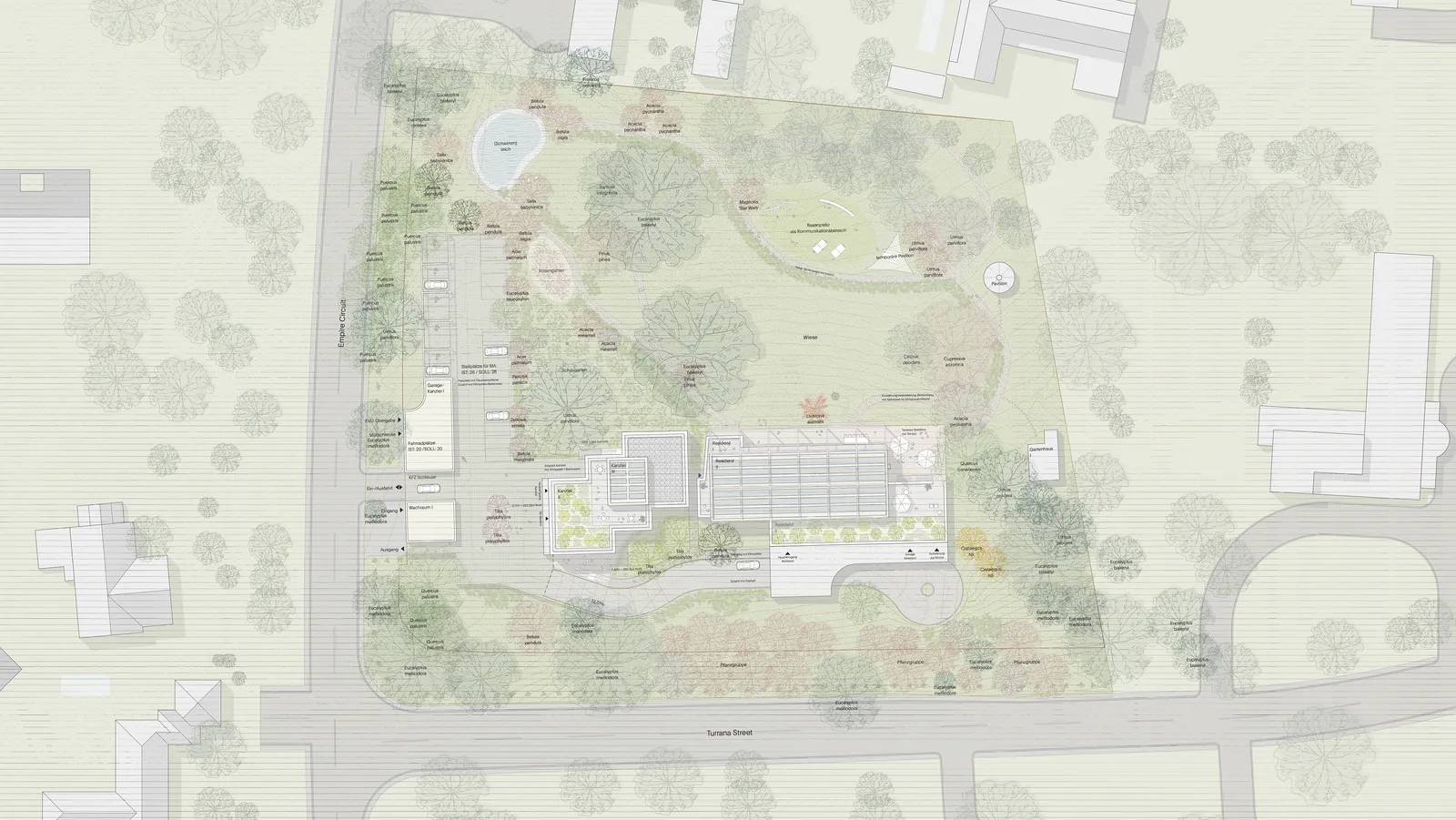
There is a particular focus on minimising sealed surfaces. The park-like garden is to be retained as a central design element and its quality enhanced. The aim is not only to preserve the character of the site through careful intervention and the retention of as many existing structures as possible, but also to make efficient use of grey energy. The buildings are logically oriented in a north-south direction in order to create optimal conditions in terms of both energy and functionality.
In the interests of compact and resource-saving planning, the new law firm will be located in the area of the former west wing – the former service wing. In this way, already sealed surfaces will be reused and additional soil sealing will be effectively counteracted. At the same time, this placement allows for the preservation of a large part of the tree population worthy of protection, optimal orientation and the preservation of the large open space in the northern part of the property. The landscape architectural design is based on an examination of the historical garden plans and a sensitive approach to the topography, vegetation and climatic characteristics.
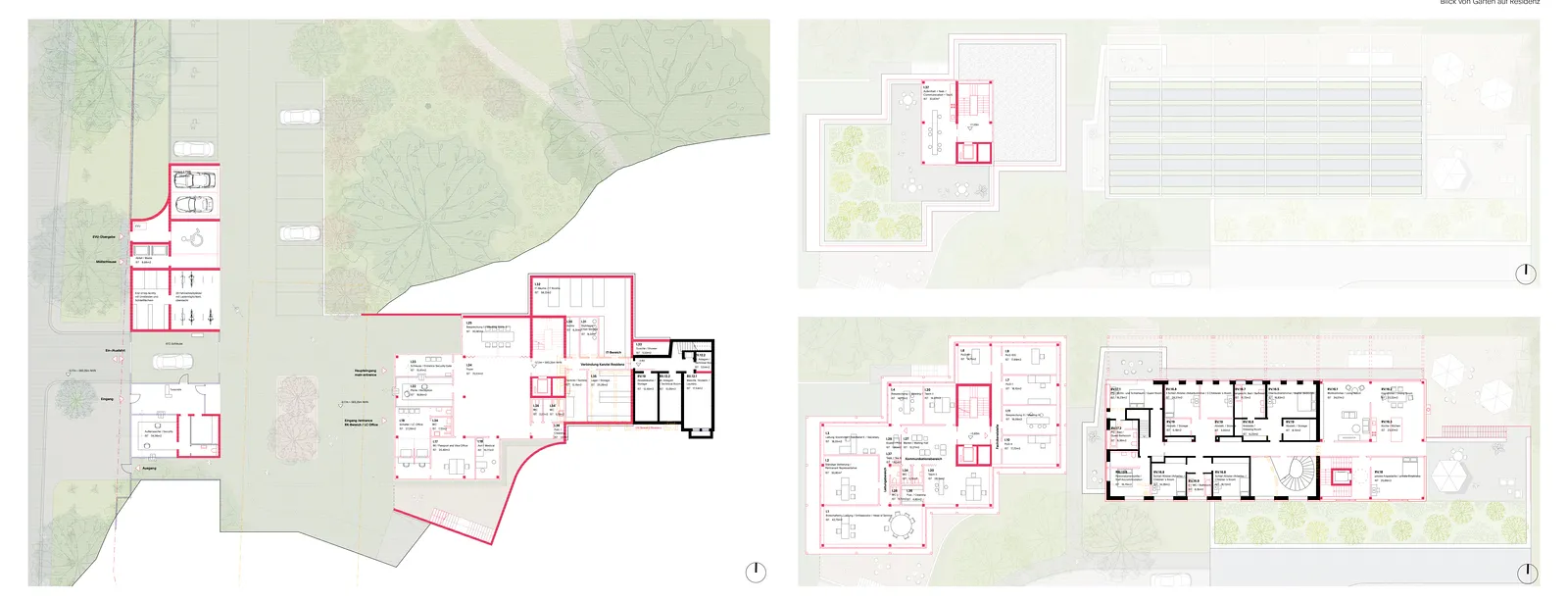
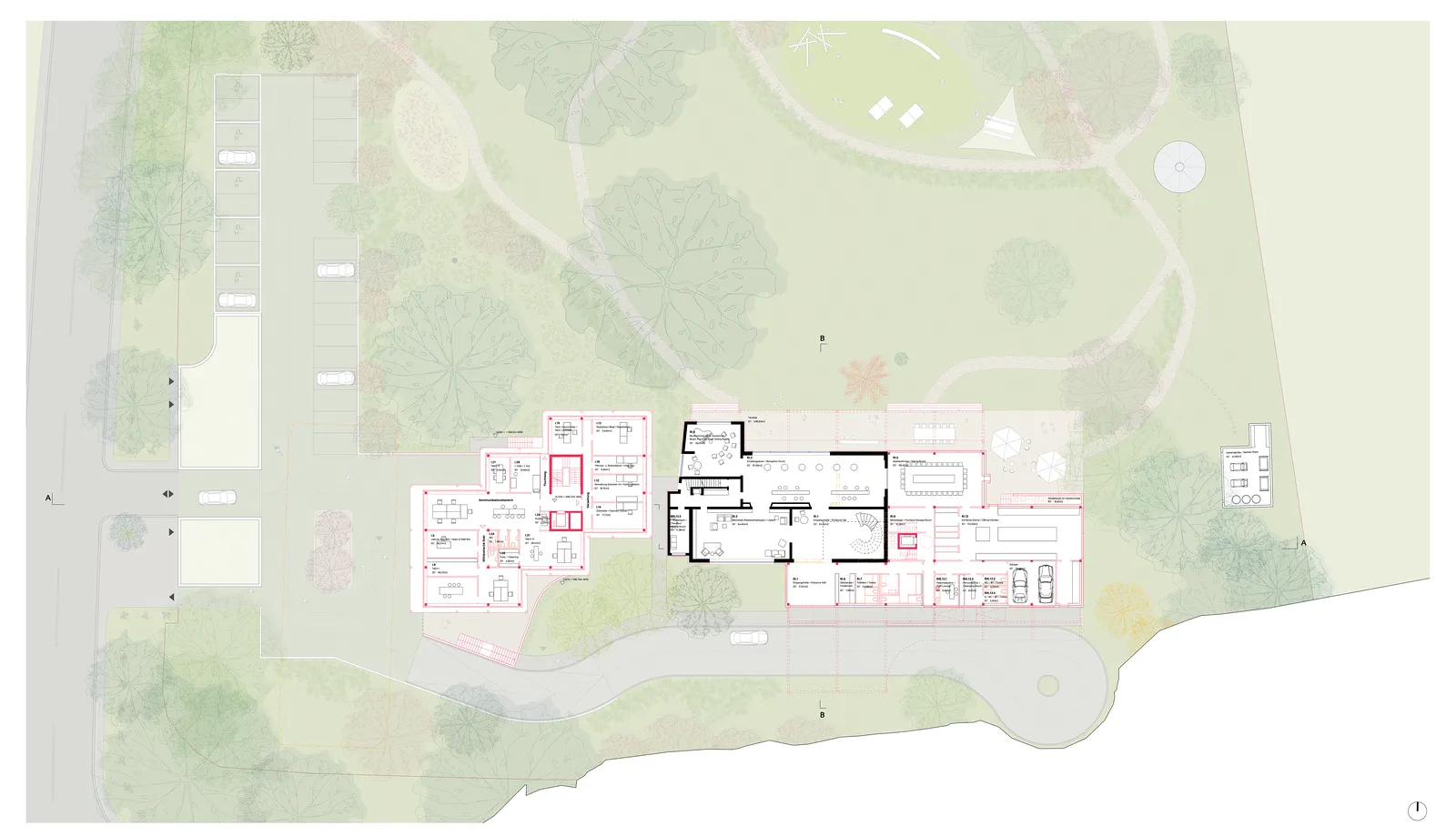
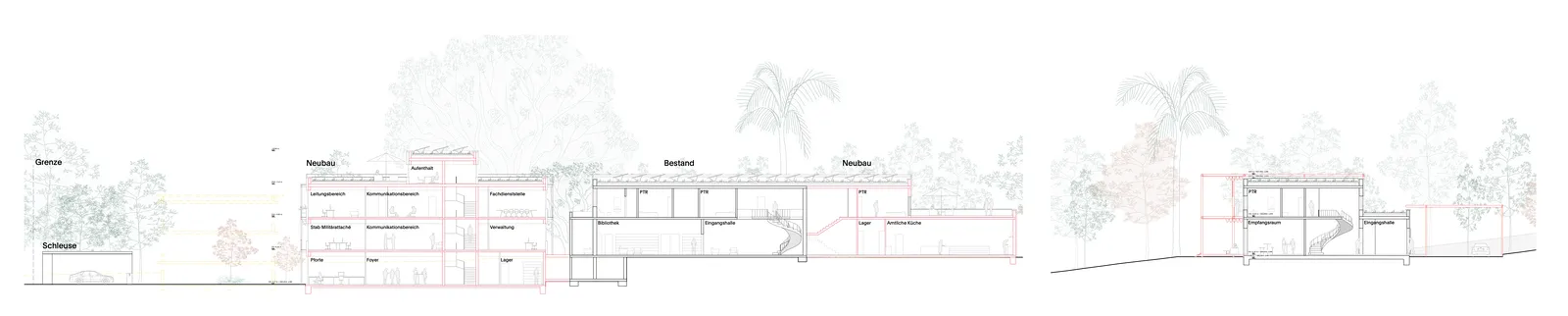
By deliberately concentrating the buildings in the southern part of the site, the area required for traffic and access routes is significantly reduced. The new law firm will be positioned in such a way that its construction and commissioning can already take place during the demolition of the existing buildings. The resulting excavation pit will be integrated into the concept: a new forecourt and access to the law firm below the ground floor of the residence will be created here. The new law firm itself is designed as a two-storey building with a converted basement and a communal lounge area on the roof. The latter opens onto a spacious roof terrace and offers high-quality rooms for breaks, exchanges and encounters.
The overall result is an ensemble that offers a forward-looking solution with great consideration for the existing buildings and landscape, as well as incorporating ecological, functional and urban planning aspects – sustainable, locally rooted and identity-forming.

The architectural design for the new embassy in Canberra aims to represent the Federal Republic of Germany in a dignified and contemporary manner in its host country. In addition to adequately representing German identity and values, the focus is also on the functional implementation of the complex processes in the chancellery and residence. The result is a building ensemble that radiates openness, sovereignty and modernity while meeting the high standards of sustainability, security and quality of use.
In line with the German government's goal of achieving a virtually climate-neutral building stock by 2045, the design meets the highest energy standards. This takes into account not only the operation of the buildings, but also their construction. The new building is expected to achieve the highest rating of 6 stars in the Australian Green Star rating system. Sustainable building materials, optimised building designs and the sensitive use of resources are integral parts of the concept.

While the ground floor, with its components in contact with the ground, is constructed as a robust reinforced concrete structure, the floors above are built using high-quality, environmentally friendly timber construction methods. This combination combines structural efficiency with a resource-saving construction method, while also creating spaces of high aesthetic and atmospheric quality. The result is healthy, inspiring and attractive working and living environments that meet the high functional and representative requirements of the embassy.
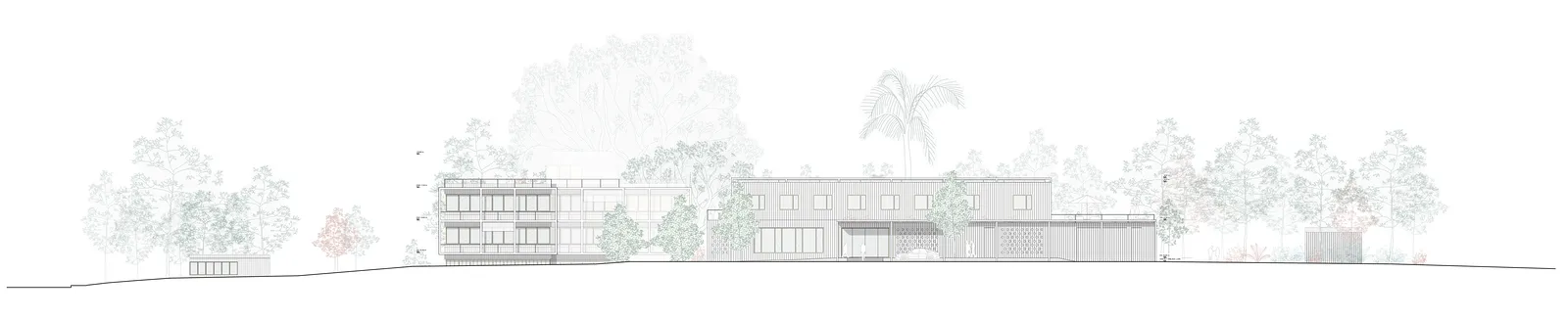
The sculpturally shaped façades do much more than just contribute to the building's external appearance: they meet the highest standards in terms of sustainability, ease of maintenance, safety, durability and structural sun protection – while also giving the building ensemble a distinctive, recognisable character. The vertically structured aluminium façades with their varying amplitude create a lively interplay of light and shadow reminiscent of a lightly falling curtain. Their design varies depending on the respective use of the building, thus reinforcing the differentiation between the functional areas.
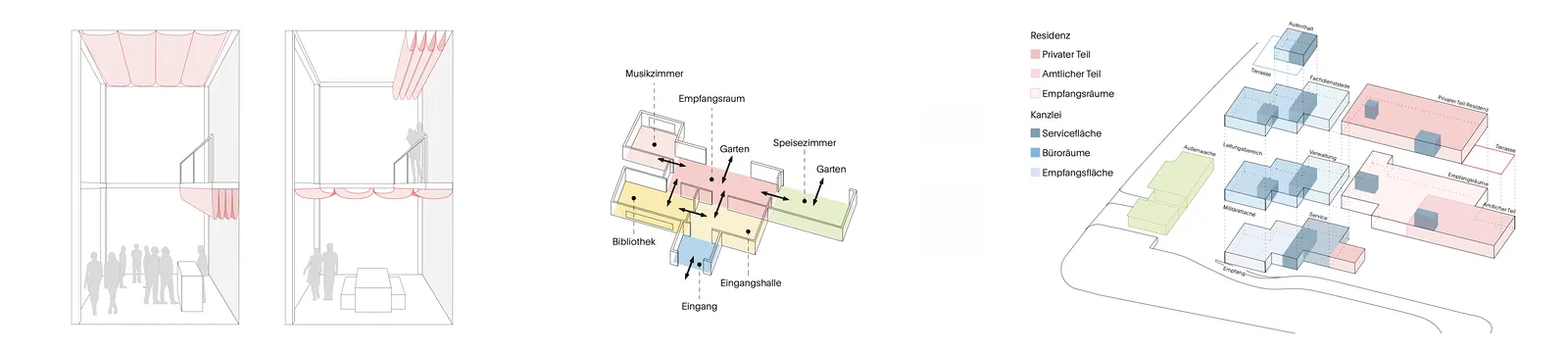
The slightly reflective surface of the façade elements enables a subtle connection between nature and architecture: the building enters into dialogue with the surrounding green space and blends harmoniously into the landscape. A special architectural element is the three-dimensional spatial framework on the north side of the residential building. This can be flexibly used on two levels thanks to textile horizontal elements. Depending on the time of day, season or event format, this creates variable and atmospherically dense spatial sequences that offer a special quality in terms of both function and design.


Residence
The existing main building of the residence will be preserved and sensitively developed in line with sustainability principles. The official area will be supplemented in the eastern part by a two-storey extension and an L-shaped service wing. This extension will be constructed as a timber frame building, which meets both economic and ecological requirements.
Inside, distinctive elements such as the high-quality parquet flooring and the striking staircase will be retained, while the building envelope will be upgraded to improve energy efficiency and adapted to the design of the new buildings. For security reasons, the building appears rather closed off from the street, but opens up generously towards the garden. A canopy on the south side creates a sheltered arrival area, while on the north side, a structural space frame allows for a variety of shading scenarios and a newly added balcony.
Law firm
The new law firm will be integrated into the existing tree population west of the residence. The building volume consists of three slightly offset structures, which are oriented from southwest to northeast. This staggered arrangement serves both to optimise lighting and to preserve as many trees as possible. The natural topography is used to place the ground floor of the law firm at the same level as the residence, while access from the street is one level lower. Earthworks are kept to a minimum by using existing basements.
The functional requirements – such as efficient workflows, high flexibility and future-proof technology – are combined with a strong representative effect. The result is a building complex that meets both internal functionality requirements and Germany's external image.

Competition:
Specialist planners:
c4 engineers (structural engineering)
Schüller Landschaften (landscape architecture)
Cape Engineers (energy concept)
JPW, Architectural Practice, Sydney (consulting)
Visualization:
Flooer